How to find investigators and sites for a new study
Start from the physicians already running studies in your indication, then read the site lists of their recruiting trials. Each site with a registered investigator is a named lead with the protocol experience you need.
By FindMyKOL Team6 min read6 steps
Key takeaways
- The fastest public route to candidate sites is a comparable study that is recruiting now: ClinicalTrials.gov names the investigator at each of its sites until enrollment closes.
- In the FindMyKOL directory on 19 November 2026, 1,050 US profiles in lupus (SLE) had at least one registered trial: 135 rheumatologists and 100 nephrologists.
- The trial count on a profile covers every registered study, in any indication. Open the trials section to see which studies match yours.
- VIBRANT (NCT05201469), a phase 2 lupus nephritis study, lists 17 sites. At least three of them are nephrology divisions, so a rheumatology-only search misses part of the site pool.
- The registry is typed by sponsors. Check each investigator's name and affiliation against the profile before you contact the site.
The quickest free way to find investigators and sites for a new study is to read the site lists of comparable studies that are recruiting now. ClinicalTrials.gov names every site of a registered study and, while the study recruits, the investigator at each one. Filter to your indication, open a recruiting study, and copy its sites.
Clinical operations and feasibility teams often need that first list before a vendor database is in place, and the public record answers more of it than most people expect. This walkthrough builds the list for a lupus nephritis study. It starts from the directory, moves to physicians who already run lupus trials, and ends with the sites of a recruiting study and the named investigator at each. The figures were pulled on 19 November 2026. The same steps work in any indication.
- 1
Filter the directory to your indication and to trial activity
Open the directory. Set the indication to the one your study enrolls, for example Lupus (SLE), and require clinical trials in the activity filter. Add the country or a region if the study is regional. Sort by Most trials.
On 19 November 2026 this returned 1,050 US profiles. Add a specialty to split the list: 135 rheumatologists and 100 nephrologists. Run both if your study population is seen by more than one specialty. Lupus nephritis is one such case.
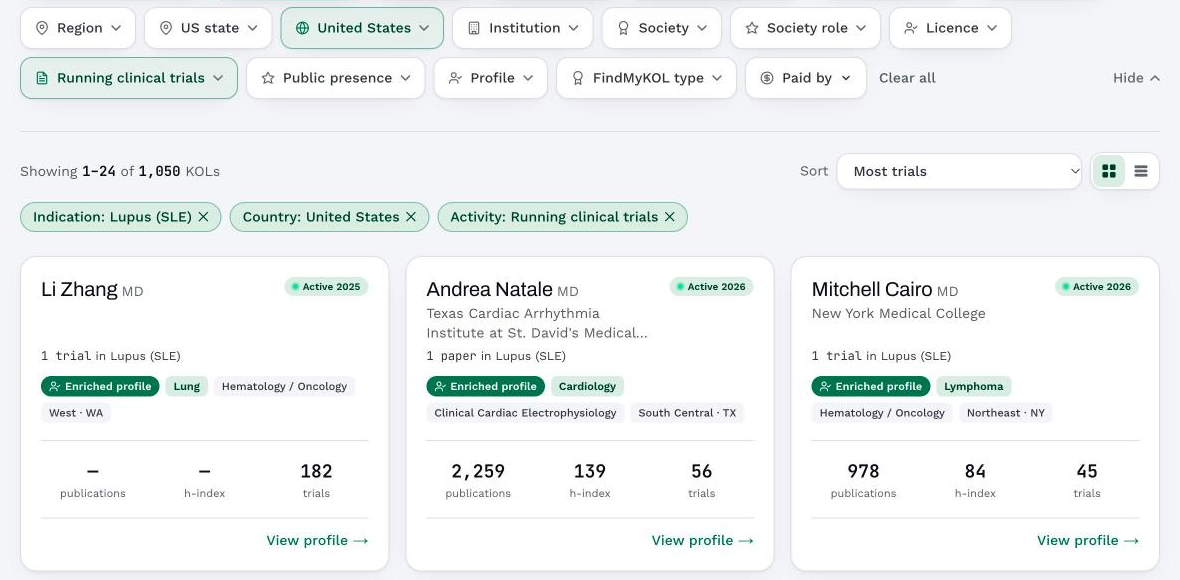
The indication, country and trial-activity filters on, sorted by Most trials. - 2
Read the trials section to find comparable studies
The trial count on each card covers every registered study the physician is named on, in any indication. A physician with many trials may have few in yours. Open the profile and read Trials before you rank anyone.
Look for studies that match yours on population, phase and design, and note which ones are still recruiting. Cynthia Aranow at the Feinstein Institutes is an example. Her profile lists 12 registered studies. Nine name lupus or lupus nephritis in the title, and four of the 12 were recruiting on 19 November 2026.
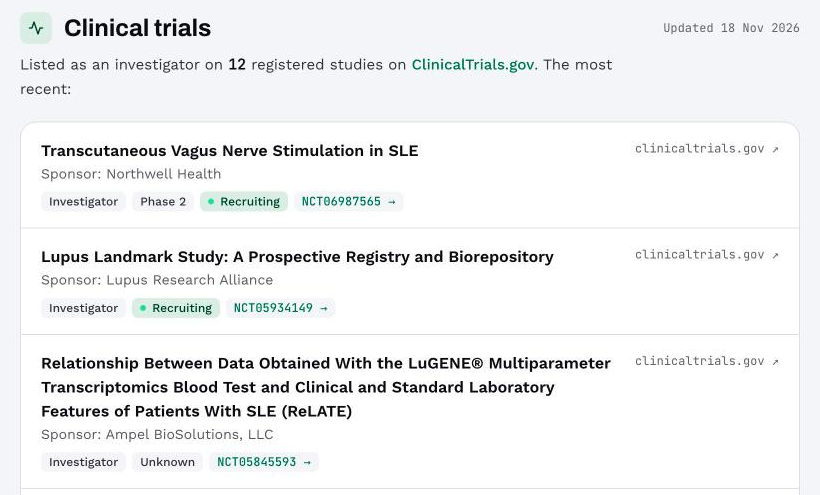
Each study shows the sponsor, her role, the phase and whether it still recruits. - 3
Open a recruiting study and list its sites
Click the NCT number to open the trial page. VIBRANT (NCT05201469) is a phase 2 study of VIB4920 in active lupus nephritis, sponsored by NIAID, with an estimated enrollment of 74. Three study chairs are registered as overall officials.
Below them the page lists every site with its city and status. VIBRANT has 17: 15 recruiting, one not yet recruiting and one withdrawn. Copy each recruiting site and its named investigator into your list. Those 15 investigators are already running a lupus nephritis protocol, which is the experience a feasibility questionnaire asks about.
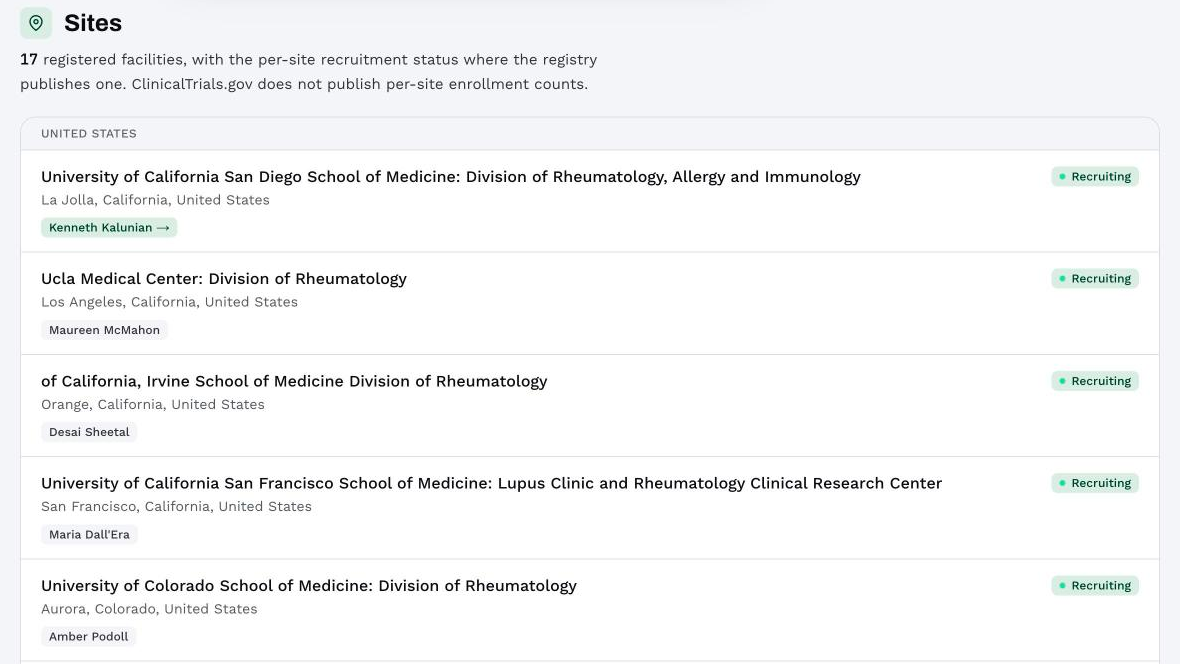
The site list names the investigator at each recruiting site. - 4
Note which department each site sits in
The facility name often names the division. On VIBRANT, the University of Miami, Washington University in St. Louis and Temple University sites are nephrology divisions. Most of the rest are rheumatology.
This tells you which specialty to search next. Gabriel Contreras, the Miami site investigator, is a nephrologist. His profile shows one registered trial, so he would not appear near the top of a list sorted by trial count. The site list found him where the ranking did not.
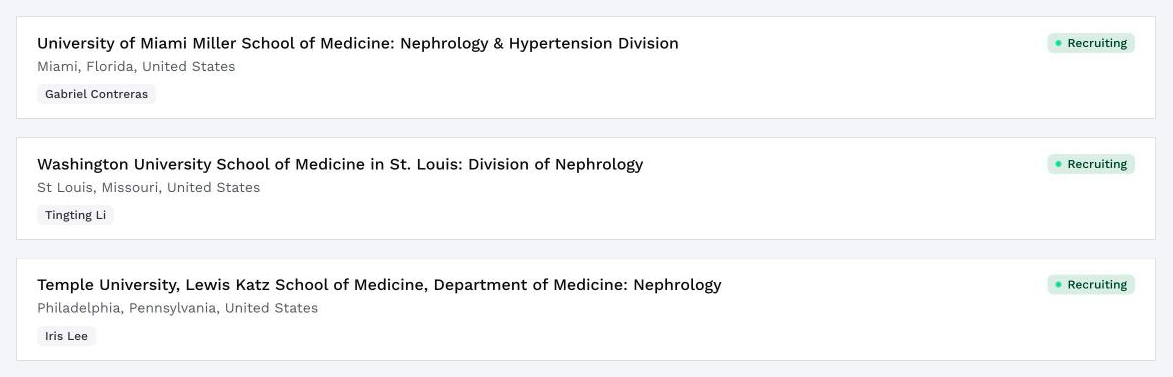
Three of VIBRANT's 17 sites are nephrology divisions, not rheumatology. - 5
Check each investigator against the profile
Search each site investigator by name in the directory and compare the institution on the profile with the facility on the registry. They do not always agree. On VIBRANT, Anca Askanase is the investigator at the Columbia University site, and her profile lists the Hospital for Special Surgery. Ask which site she now works from before you plan a visit.
Read the names with care. Sponsors type them into the registry, and two VIBRANT site investigators appear with given name and surname reversed. Search both orders when a name does not match.
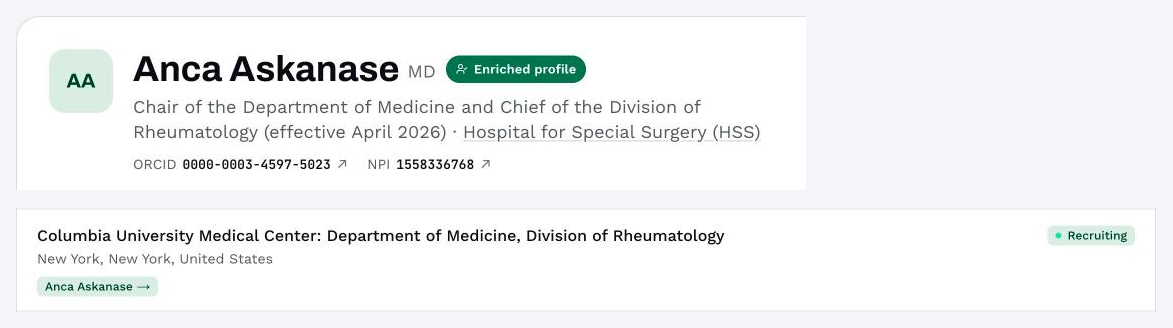
The profile and the registry disagree on her institution, so ask before you plan a visit. - 6
Repeat for two or three comparable studies
One study gives you one sponsor's site list. Repeat steps 3 to 5 for two or three recruiting studies in the same indication, ideally from different sponsors. Sites that appear on more than one list already have the staff and the patients for this population.
Save the investigators you keep to a board so the list stays with your team.
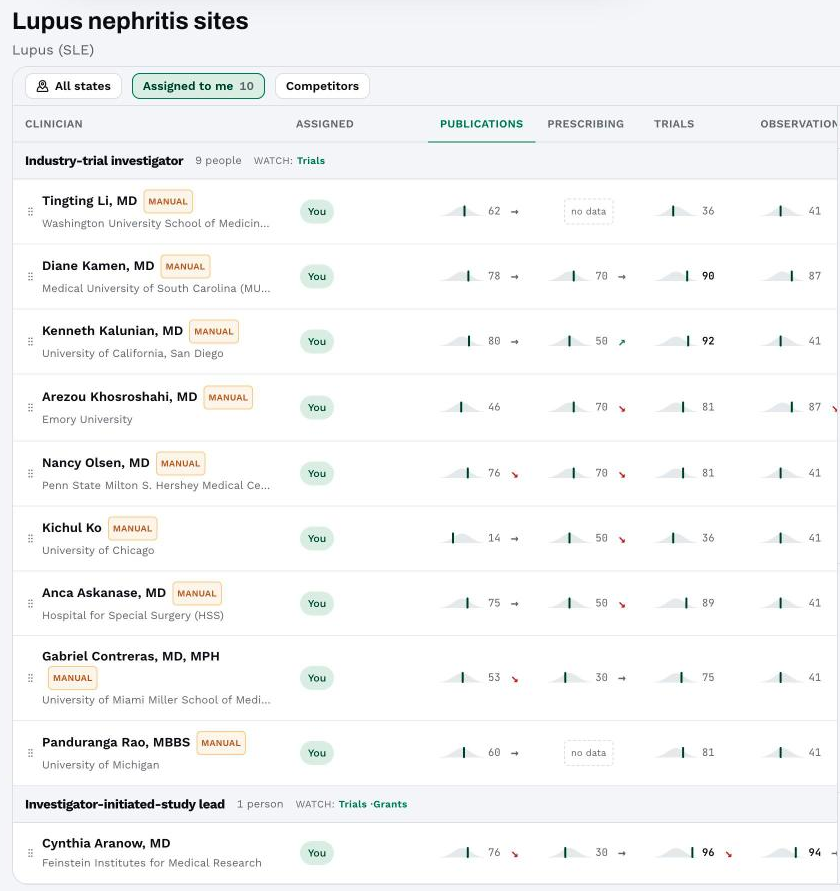
Ten of VIBRANT's site investigators, saved to one board.
Where does the public record stop?
The registry tells you who runs a protocol and where. It does not tell you how well. ClinicalTrials.gov has no per-site enrollment, screen-failure rate, start-up time or audit history. It names site investigators only while a study recruits, and it never names sub-investigators or study coordinators.
| What feasibility needs | In the public record |
|---|---|
| Sites running a comparable protocol | Yes, on the study's site list |
| Site investigator | Yes, while the study recruits |
| Sub-investigators and coordinators | No |
| Enrollment by site | No, only the study total |
| Site performance and audit findings | No |
Use the public record to build the long list, then send the feasibility questionnaire for everything below the line. To start, open the directory, set your indication and sort by Most trials. For one physician's full trial history, see finding every trial a physician has worked on.
Questions
- How do I find clinical sites for a new study?
Start from comparable studies that are recruiting now. ClinicalTrials.gov lists every site of a registered study and, while it recruits, the investigator at each one. Filter the FindMyKOL directory to your indication and trial activity, open a recruiting study, and copy its sites and investigators into your long list.
- Where can I find investigators for a clinical trial for free?
ClinicalTrials.gov is the main free source. While a study is recruiting, it lists each site and, where the sponsor registered one, the site investigator. Search for recruiting studies in your indication and read their site lists.
- How do I find a clinical site in a specific region?
Add the region or state to the indication and trial-activity filters in the directory, then read the site lists of recruiting studies in your indication. Each site row gives the city and status, so you can keep only the sites in your region. The site does not have to be an academic center: community practices appear on site lists too.
- What goes into a site feasibility report?
Two layers. The public record gives the long list: sites running a comparable protocol, the site investigator and whether the study still recruits. Everything else comes from the site through a feasibility questionnaire: enrollment by site, screen-failure rate, start-up time, staff and equipment. Use the public record to narrow to a short list before you send questionnaires.
- Does ClinicalTrials.gov show enrollment numbers per site?
No. It shows the target or actual enrollment for the whole study, not for each site. Per-site enrollment is in the sponsor's own records, which are not public.
- Why does a completed study show sites but no investigators?
ClinicalTrials.gov publishes site investigator names only while a study recruits. When enrollment ends, the site list stays and the names are removed. Use recruiting studies when you need names.
- Is a high trial count a sign of a good site?
Not on its own. The count covers every registered study in any indication, and it says nothing about enrollment or data quality. Use it to find experienced investigators, then ask about performance in the feasibility questionnaire.