Building a starter KOL list for a new territory
Two filters and one sort turn the directory into a first territory list: for multiple myeloma in the Midwest, 855 KOLs, 338 of them with registered trials.
By FindMyKOL TeamUpdated 4 min read5 steps
Key takeaways
- Start with two filters, indication and region, then sort by trials or publications.
- Multiple myeloma in the Midwest returns 855 KOLs in the directory; 338 have at least one registered clinical trial.
- Use the cards to cut the list, then open the profiles on your shortlist: the filters match records, and you decide who belongs.
- Add KOLs on My Feed puts a name on your Personal board at no cost. Opening a profile's itemized records does the same.
A new territory usually arrives without a usable list, and the first meeting with your medical director is about who you plan to see. This walkthrough builds a defensible starting list from the public record in an afternoon, using one real example throughout: an MSL covering multiple myeloma across the Midwest.
Every number below comes from running these steps in the directory on 16 November 2026. Your counts will differ by indication and will move as the records update.
- 1
Filter to your indication
Open the directory and choose your indication from Indication. The filter matches physicians whose records are tagged with the disease, so it reaches beyond the specialty name.
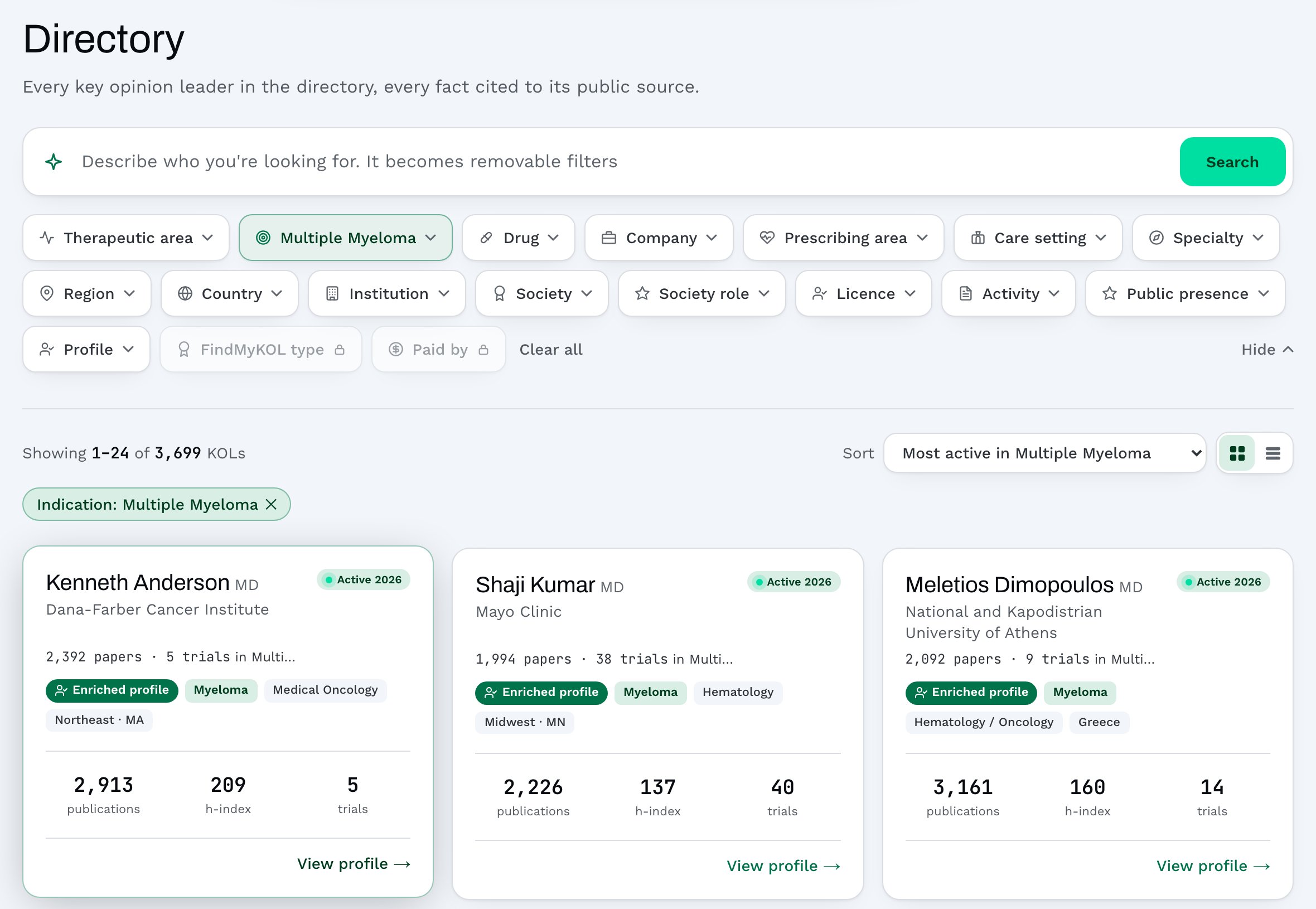
One filter: every KOL whose records are tagged with multiple myeloma. - 2
Add your region
Choose your territory from Region. Regions follow common MSL territory lines; the Midwest covers Illinois, Ohio, Michigan, Indiana, Wisconsin, Minnesota, Iowa, Missouri, Kansas, Nebraska and the Dakotas.
Multiple myeloma plus Midwest returned 855 KOLs.
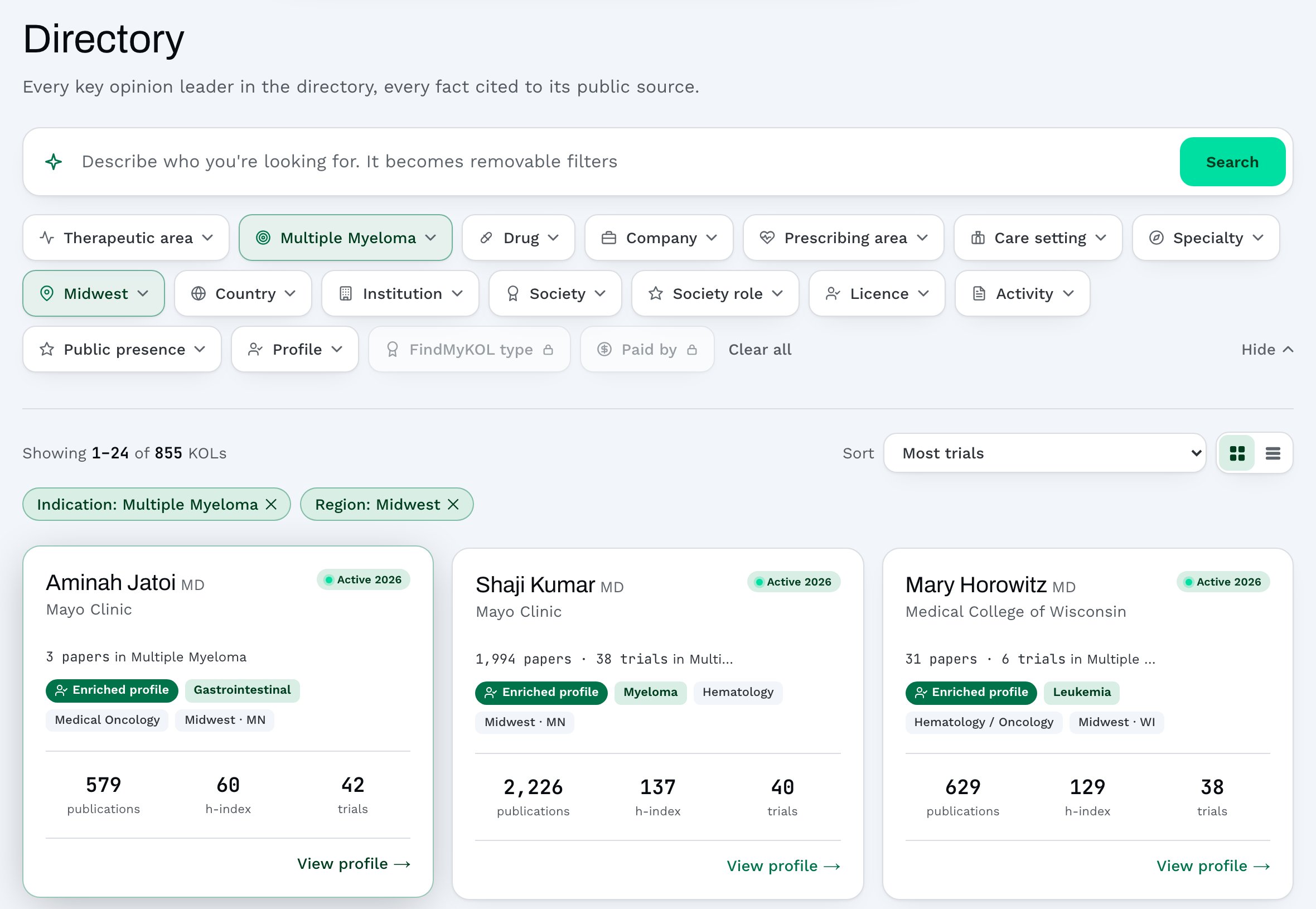
Two filters: 855 multiple myeloma KOLs in the Midwest. - 3
Sort by trials and keep the active researchers
Set Sort to Most trials, or Most publications if your plan leans toward scientific exchange over trial support. With one indication chosen, the directory opens on Most active in Multiple Myeloma, which ranks by work in that indication. Most trials ranks by all registered trials. Then open Activity and choose Running clinical trials to keep only physicians with at least one registered study.
Filters applied KOLs Multiple myeloma, Midwest 855 Plus at least one registered trial 338 The top three by registered trials were all at Mayo Clinic or the Medical College of Wisconsin, with 38 to 42 studies each.
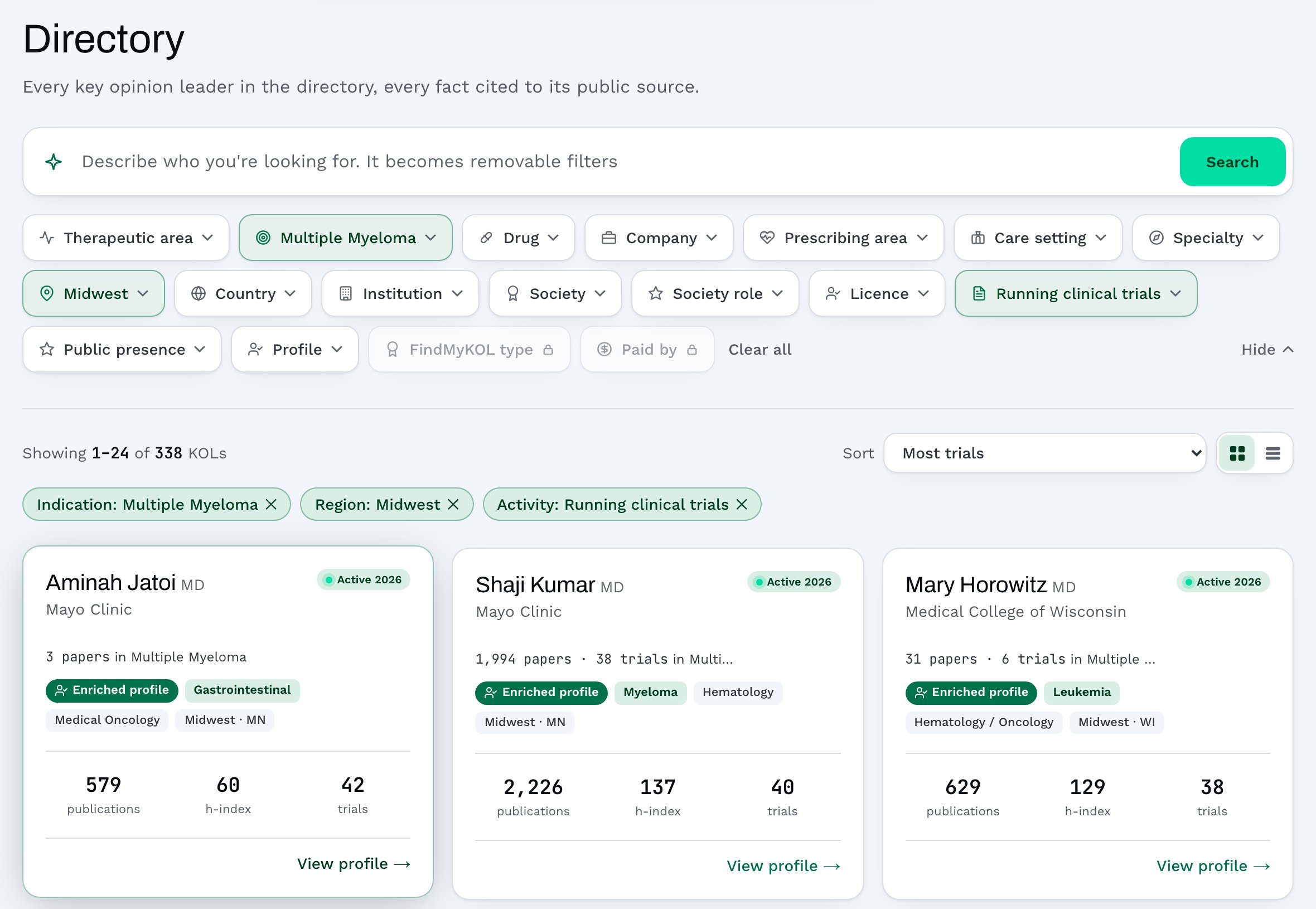
The activity filter keeps the 338 KOLs with at least one registered trial. - 4
Cut the list from the cards, then read the shortlist
The filters match records; whether someone belongs on your list is your call. Start with the cards. Each one shows the specialty and indication tags, the institution and region, and the publication and trial counts, which is enough to drop the obvious mismatches: a medical oncologist tagged mainly for gastrointestinal cancers may have matched on a single myeloma study.
Then open the profiles on your shortlist and check the Focus line, the most recent trials and their status, and the institution and city, so the person sits where your territory does. A free account opens five profiles in total, and opening one again is free. The pricing page lists what the paid plans add.
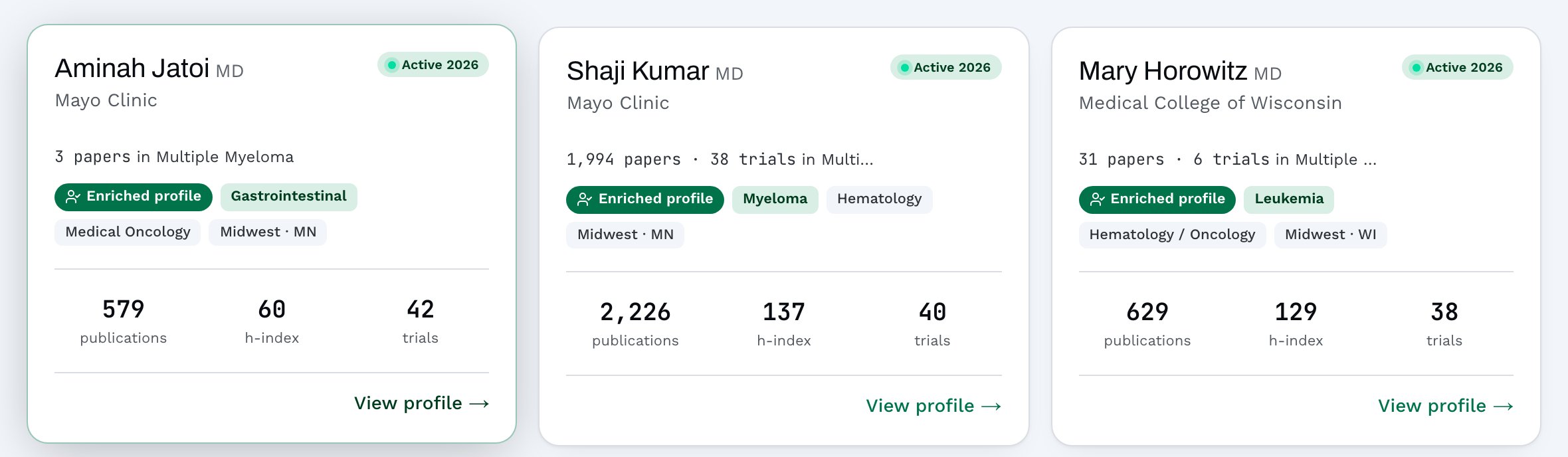
The cards carry enough to drop a mismatch: tags, institution, region and counts. - 5
Save the ones you keep
Open My Feed in your workspace and click Add KOLs. Search a name and press the plus, or paste a list of NPIs or ORCID iDs, and choose Personal as the board. Saving uses no credits. The Unlock the itemized profile button costs 5 credits, and a free account starts with 65. It opens the itemized records and puts that KOL on your Personal board. The board is the list you take into your territory plan, and each name on it links back to the records that put it there.
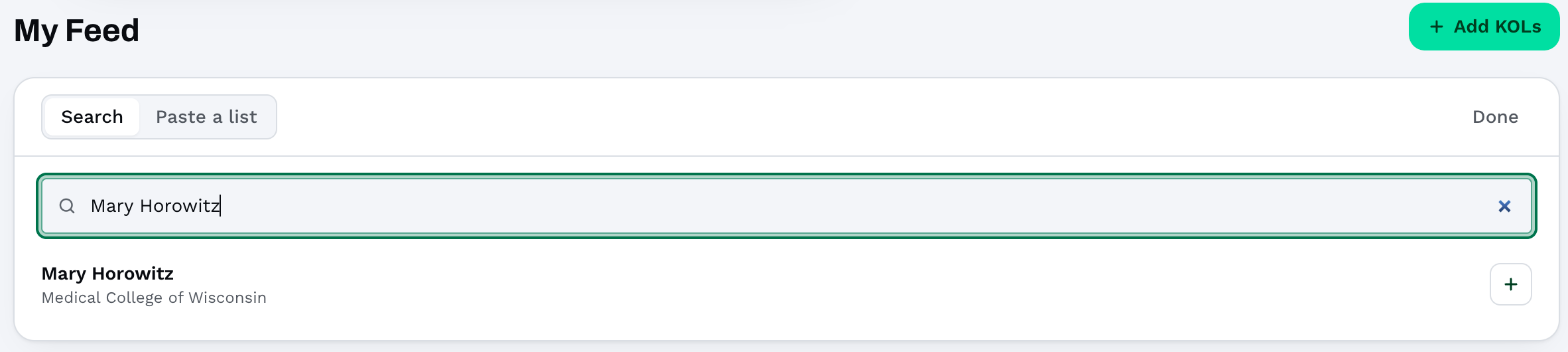
Add KOLs on My Feed: search a name, then press the plus to put it on a board.
What is a starter KOL list, and what is it not?
A starter KOL list is the set of physicians whose public record ties them to your indication and region: registered trials, publications, NIH grants and congress activity. In the multiple myeloma example that was 855 KOLs in the Midwest, 338 of them with at least one registered trial, on 16 November 2026. It is not a ranking of influence, and it does not know who is accessible, who prefers MSL contact, or who your colleagues already see. Those come from your CRM and your team. What the public record gives you is a defensible starting point: every name on the list traces back to the records that put it there, which is the first thing a medical director asks about.
Before the first meetings, pull each physician's full trial history and read their role on each study: finding every trial a physician has worked on.
Can you run this search in ChatGPT?
Yes. If you work in ChatGPT, the FindMyKOL app runs steps 1 to 3 for you. Add it from the ChatGPT plugin directory and ask:
Using FindMyKOL, find multiple myeloma physicians in the Midwest with registered clinical trials, sorted by most trials.
It searches the same directory records, reports the total, and lists ten physicians at a time with their trial and publication counts; ask for the next page to see more. On 16 November the same search in the app returned the same 338, led by the same three Mayo Clinic and Medical College of Wisconsin physicians as the run above. Each name links to its FindMyKOL profile, where you read the record. Opening its itemized records adds it to your Personal board. The app holds no contact details or prescribing data, so outreach planning still starts from the profile and your CRM.
Questions
- How many KOLs should a starter territory list have?
There is no fixed number. For one indication across a multi-state region, the directory typically returns a few dozen to several hundred; most teams start by reading the top twenty to forty by trials or publications.
- Does the directory rank KOLs by influence?
Not on public pages. Public pages show the records: trials, publications, grants, payments and congress activity. The FindMyKOL type (Elite, National, Regional) is a judgment shown on revealed profiles.