A 15-minute public-record check before a first KOL meeting
Six reads on one profile, in order: confirm the person, see the shape of the record, find the recruiting studies, match this year's papers to this year's talks, check funding and co-authors, then read the payments for context.
By FindMyKOL Team5 min read6 steps
Key takeaways
- Confirm the person first: the NPI and ORCID on the profile header settle a common name before you read anything else.
- Recruiting studies are the most concrete topic for a first conversation; the trials section lists the most recent with phase, sponsor and status.
- Read recent publications and congress abstracts together: a talk one year often becomes a paper the next, and it tells you what the physician is working on now.
- Industry payments are reported transfers of value under the Open Payments program. They describe a relationship, not a judgment about it.
To prepare for a first KOL meeting in 15 minutes, read one public profile in six steps: confirm the person, read the totals, find the recruiting studies, read this year's papers next to this year's talks, check funding and co-authors, then read the payments for context.
A first meeting goes better when you already know what the physician is working on this year. Most of that is in the public record, spread across PubMed, ClinicalTrials.gov, NIH RePORTER, congress abstracts and CMS Open Payments. A FindMyKOL profile puts those records on one page, each linked to its source. Here is the order to read one in.
Every example below comes from one public profile as it read on 22 October 2026.
- 1
Confirm the person (2 minutes)
Open the profile from the directory and read the header: name, appointment, institution, region and Focus. Then check the two identifiers under the name. The NPI is the federal provider number and the ORCID is the researcher's own ID; both link out to their registries, so you can confirm you have the right person before you prepare a word.
Our example is Attaya Suvannasankha, Director of the Multiple Myeloma Program at Indiana University School of Medicine, one of the physicians a starter list for the Midwest turns up.
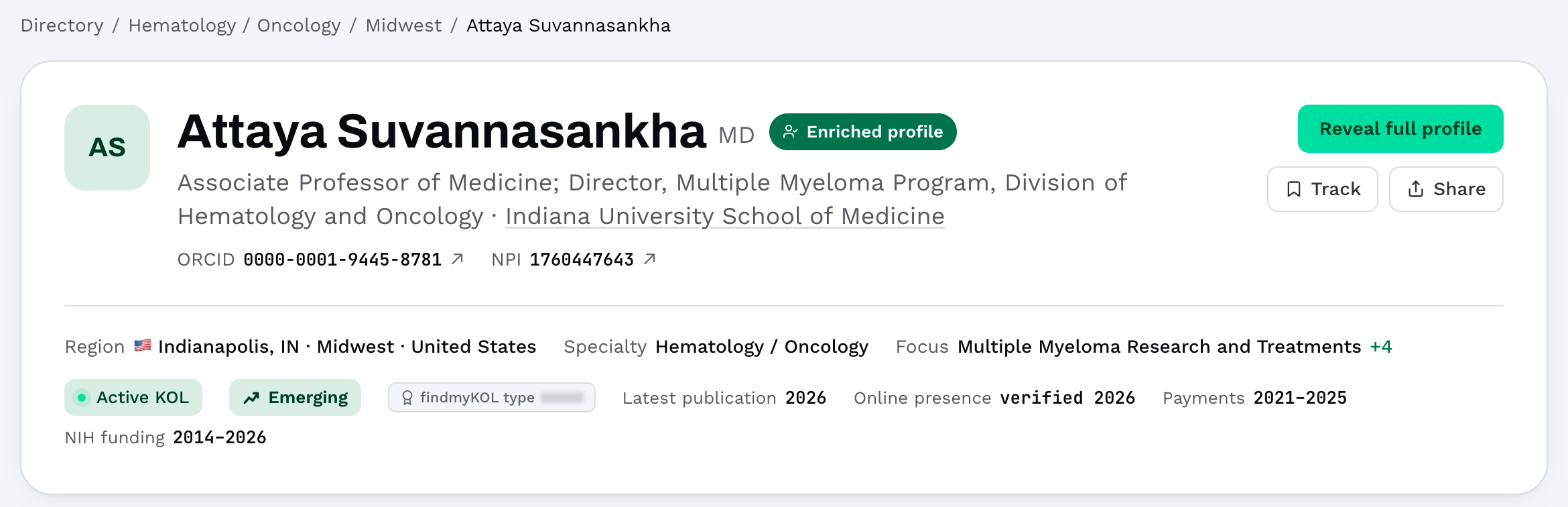
The identifiers under the name settle who this is; the row below gives region, specialty and focus. - 2
Read the overview for the shape of the record (2 minutes)
The Overview is a short summary generated from the cited records, with the totals: publications and h-index, registered trials, companies reporting payments and years of NIH funding. For Dr. Suvannasankha it reads 211 publications (h-index 30), 8 registered trials, payments reported by 15 companies between 2021 and 2025, and federal research funding from 2014 to 2026.
Below it, Indications focus counts trials by disease. All eight of her registered trials are in multiple myeloma, which tells you where a scientific conversation will land.
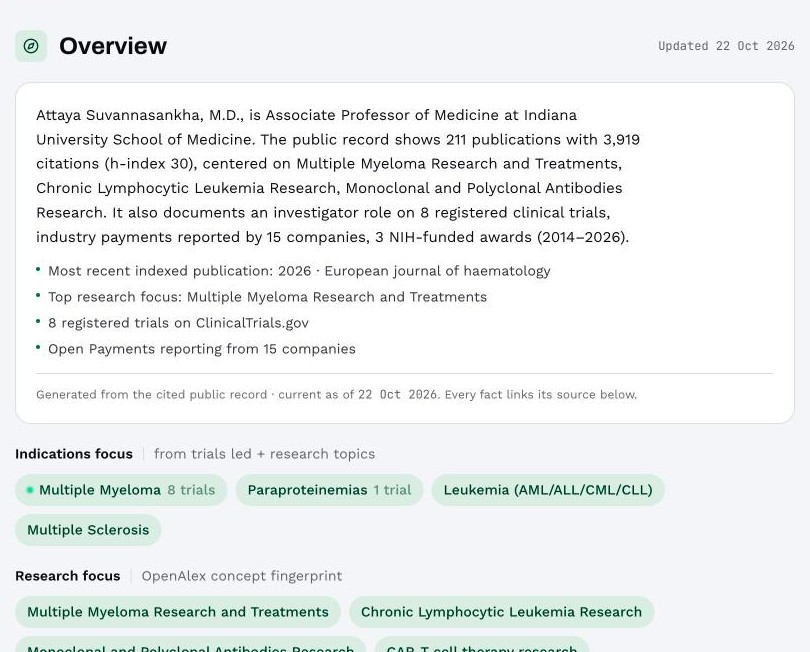
The summary is generated from the cited records; the chips under it count trials by disease. - 3
Find the recruiting studies (3 minutes)
Open Trials. The section gives the total and the most recent studies, each with sponsor, phase, status and NCT number. A recruiting study in your area is the most concrete topic for a first conversation.
Here the most recent are a phase 3 SWOG study in newly diagnosed myeloma for patients who are not transplant candidates, recruiting; the Indiana Myeloma Registry, recruiting; and a phase 2 study of frailty-guided dosing whose sponsor is the physician herself. When the sponsor line names the investigator, the study was investigator-initiated, a good sign of what she wants to study next. Its status is withdrawn, so ask about the question rather than the study.
The NCT number opens the study page with each investigator's registered role; finding every trial a physician has worked on covers what the registry does and does not record.
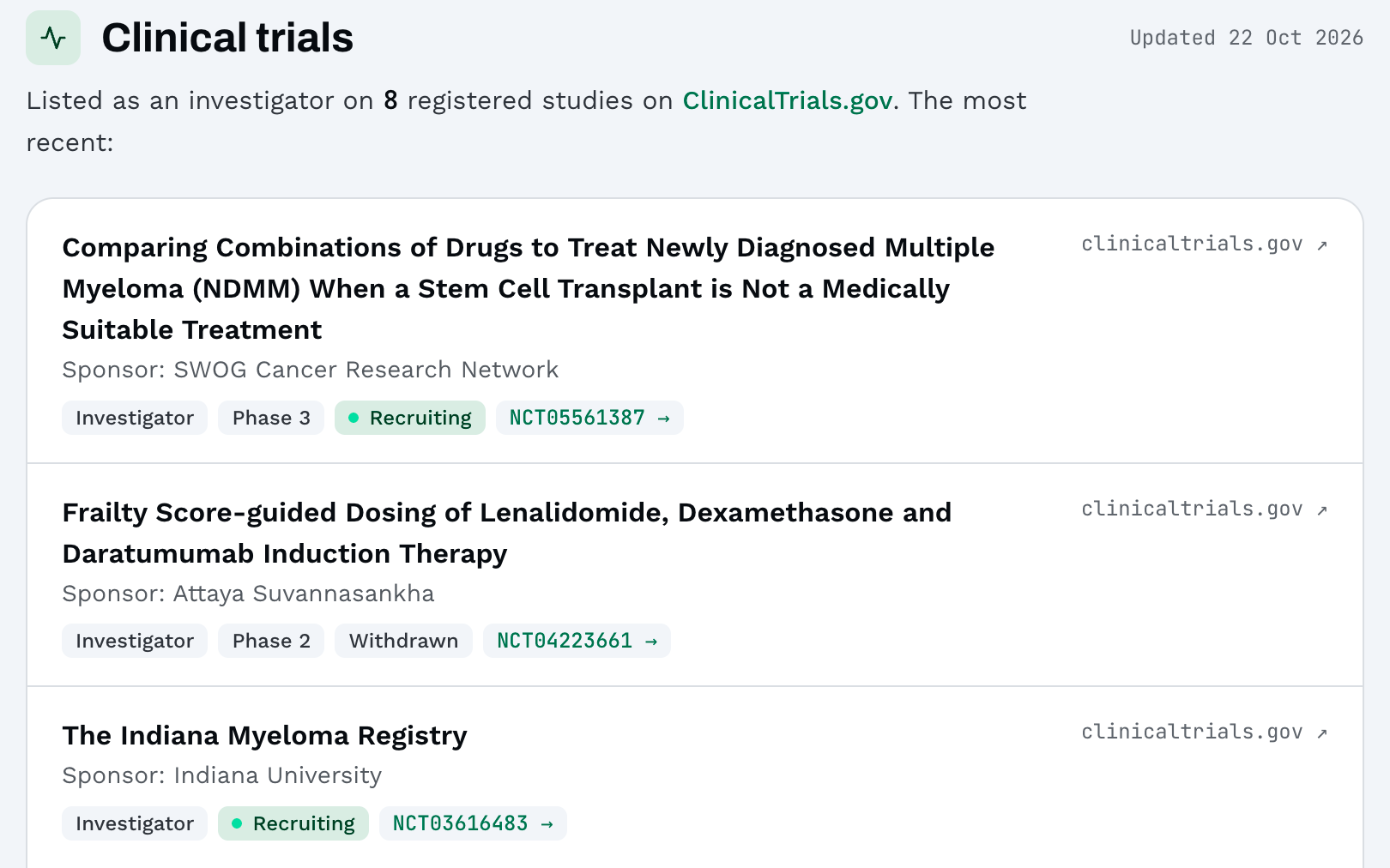
Recruiting status and sponsor are the two things to read on each row. - 4
Read this year's papers and talks together (4 minutes)
Open Publications. It lists the five most recent papers, matched to the physician's ORCID and linked to PubMed. Skip the most-cited list for now: it tells you what made the name, not what they are doing this year. Note one or two titles you could ask about.
Then open Congress activity, which lists abstracts at society meetings with the physician's role on each. Read the two lists side by side. At ASCO 2025 Dr. Suvannasankha was the presenting author on second primary malignancies after CAR T-cell therapy in myeloma; in 2026 the same question appears as a paper in Clinical Cancer Research. A topic that moves from podium to journal is one they care about.
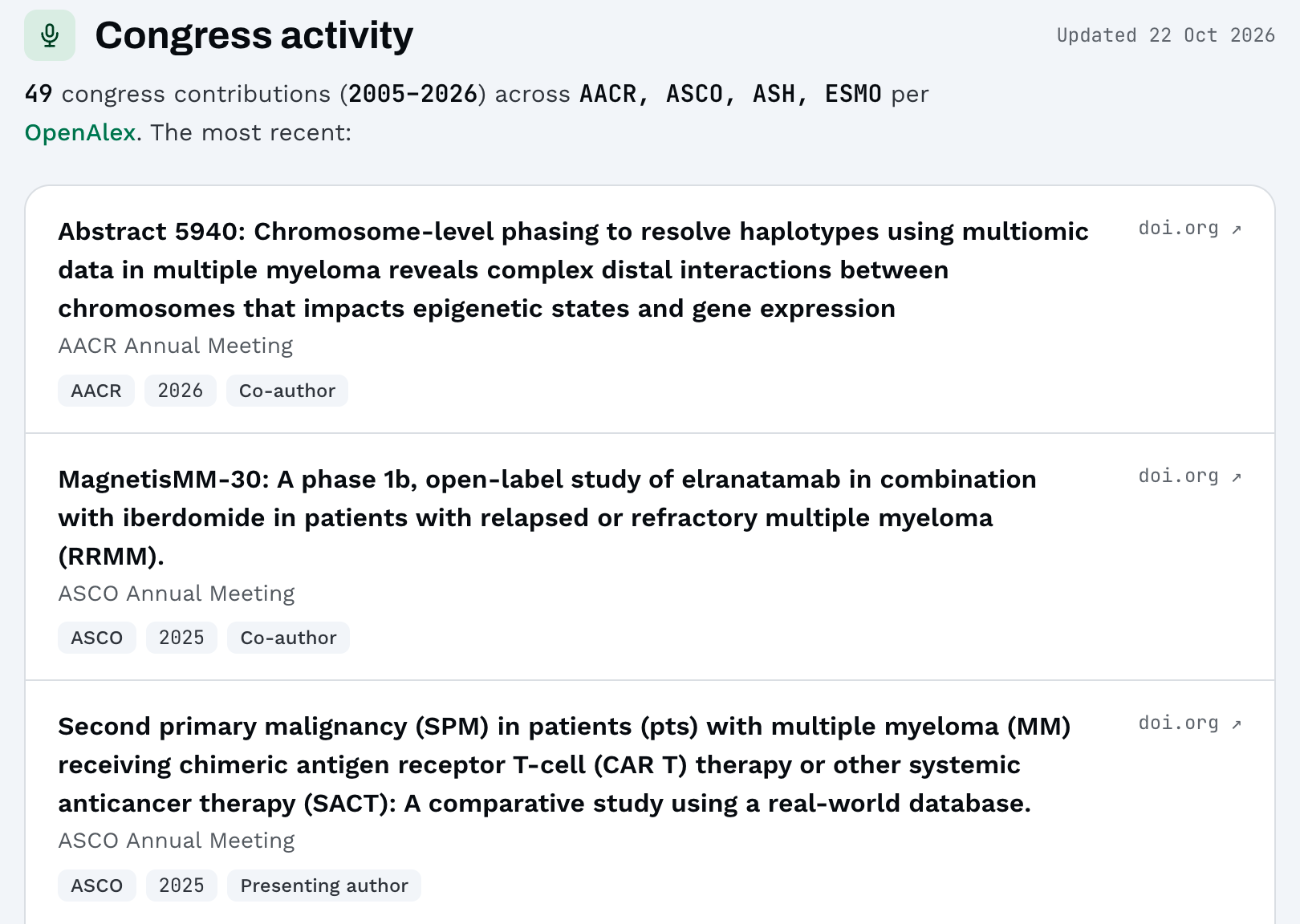
The role tag separates the talks they gave from the abstracts they co-authored. - 5
Check who funds the work and who they write with (2 minutes)
NIH funding lists federal research awards from NIH RePORTER by fiscal year, with the project title and the organization that holds the award. Read the organization line: Dr. Suvannasankha's most recent awards are VA research grants held at the Richard L. Roudebush VA Medical Center in Indianapolis, which RePORTER lists alongside NIH awards.
Network names the people they publish with most. Her most frequent co-author, Rafat Abonour, shares 85 papers with her; colleagues like that are often in the room, or the next meeting.
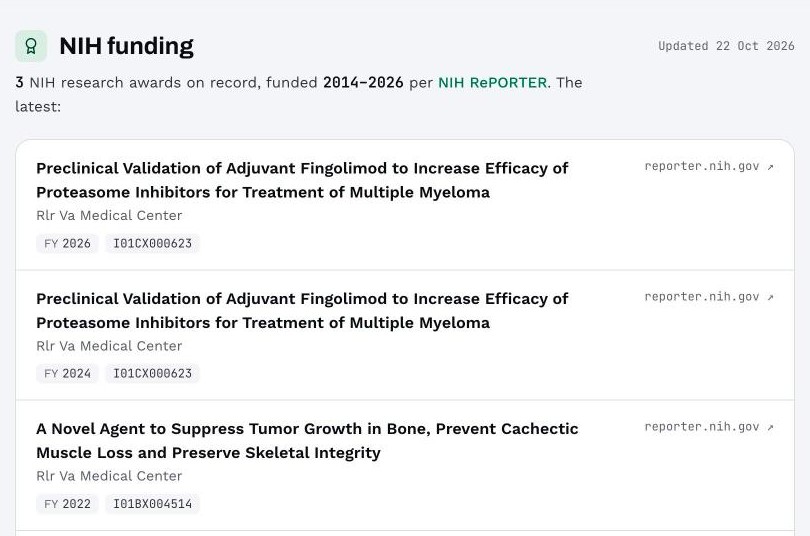
The organization line under each award is where the VA shows up. - 6
Read the payments for context (2 minutes)
Industry payments shows which companies reported payments to the physician under the CMS Open Payments program, by company and program year, each linked to the CMS record. Read it for context: which companies they already consult or speak for, and how recently. A payment record is a reported transfer of value, not a finding about the physician.
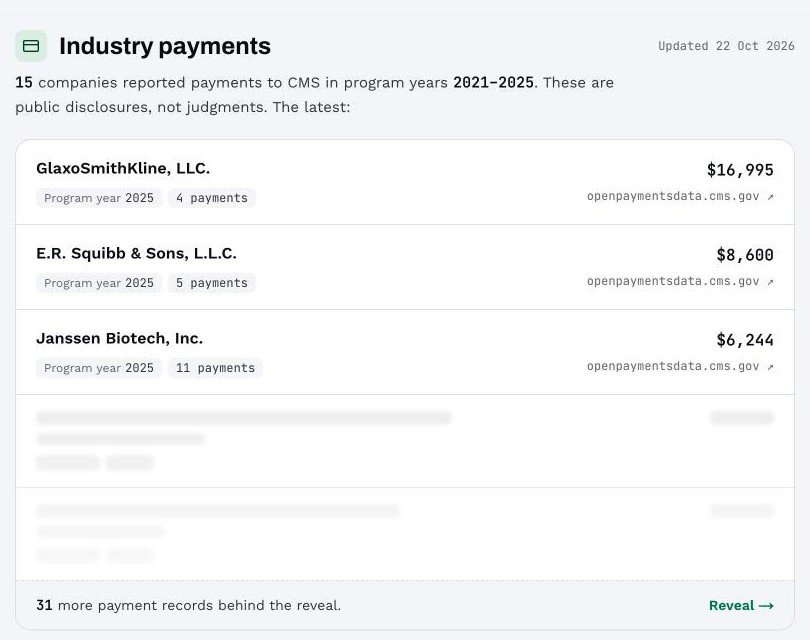
Read the company and the program year first. Each row opens the CMS record it came from.
What to bring into the room
Three notes are enough: the recruiting study closest to your area, one recent paper or talk you can ask about, and the colleagues who appear across their work. Leave the payments out of the conversation; they are context for you, not a topic.
Where the public profile stops
The public profile shows the totals and the most recent rows in each section, without an account. Signed in, you can open the itemized record and the practice contact details from NPPES.
Before you close the tab, click Track to put the profile on your board, next to the rest of your territory list.
Questions
- How do I prepare for a first meeting with a KOL?
Read their public record in six steps, about 15 minutes in all: confirm identity with the NPI and ORCID, read the totals, find their recruiting studies, read this year's papers next to this year's congress talks, check who funds the work and who they write with, then read the industry payments for context. Bring three notes into the room: one study, one paper or talk, and the colleagues around them.
- What tools do MSLs use to research a KOL before a meeting?
Most combine free registries searched by hand (PubMed, ClinicalTrials.gov, NIH RePORTER, CMS Open Payments and congress abstract books) with the company CRM for past interactions. Enterprise KOL platforms put several of those sources in one place. A FindMyKOL profile puts them on one page, with each row linked to the record it came from.
- What should I talk about in a first KOL meeting?
Their current work. A recruiting study in your therapeutic area, a recent paper or a congress talk they presented are concrete openings. Leave industry payments out of the conversation; they are context for you, not a topic.
- Where does Open Payments data come from?
From CMS. Drug and device manufacturers report payments and other transfers of value to physicians, and CMS publishes them every year.
- Why does the profile show only the most recent rows?
Public profiles show the totals, the most recent three rows in most sections and the five most recent publications, without an account. Signed in, you can open the itemized record, every trial, payment and grant as a row, and it stays open.
- Where do I find the practice address and phone number?
In Contact, from the federal NPPES registry.
- What do VERIFIED and PROVISIONAL mean under Online presence?
VERIFIED means the account was matched across two or more independent public sources, or through the NPI or ORCID. PROVISIONAL means it was found in a cited source and is still being confirmed, so check it before you rely on it.