Hematology and myeloma KOLs in 2026: the public record
1,148 profiles work in hematology, 30% of them trial investigators on 988 registered trials. Where the names sit, who leads multiple myeloma, and how to plan around ASH 2026, with every count cited.
By FindMyKOL Team7 min read
Key takeaways
- 1,148 profiles work in hematology as of November 20, 2026. 342 of them (30%) are investigators on registered trials, against 9% across oncology.
- 988 registered trials carry a hematology investigator, 169 of them recruiting now.
- Mayo Clinic, City of Hope and The Ohio State University hold the largest groups; the five largest institutions hold 21% of the area.
- Many blood-cancer leaders are filed under oncology, not hematology. For multiple myeloma, the indication search finds 3,686 US profiles and orders them by activity in the disease.
- Before ASH 2026 (December 12 to 15, New Orleans), the meeting's page lists the KOLs on its published program with their roles.
Hematology KOLs are easiest to find through the public record: 1,148 profiles work in hematology, 342 of them run registered trials, and for multiple myeloma an indication search ranks 3,686 US profiles by their work in the disease. Here is where the names sit, who leads myeloma, and how to plan around ASH 2026.
Every number below was read from FindMyKOL's hub pages and directory on November 20, 2026. Each one names the registry it comes from: ClinicalTrials.gov, NIH RePORTER, CMS Open Payments or OpenAlex.
What "hematology KOL" covers, and where the blood-cancer names live
The hematology hub lists every profile whose published research or registered trials place them in hematology, sub-areas included. Leukemia, lymphoma and multiple myeloma lead their work.
The area tag has a limit, though. Many blood-cancer leaders publish and run trials under oncology, so the directory tags them there. Kenneth Anderson and Nikhil Munshi at Dana-Farber are two of the most active myeloma physicians in the US, and both are filed under oncology rather than hematology.
So if you mean blood cancers, search by indication. The indication search in the directory finds everyone working in the disease, whatever their area tag, and the oncology hub covers the wider field.
The hematology area by the numbers
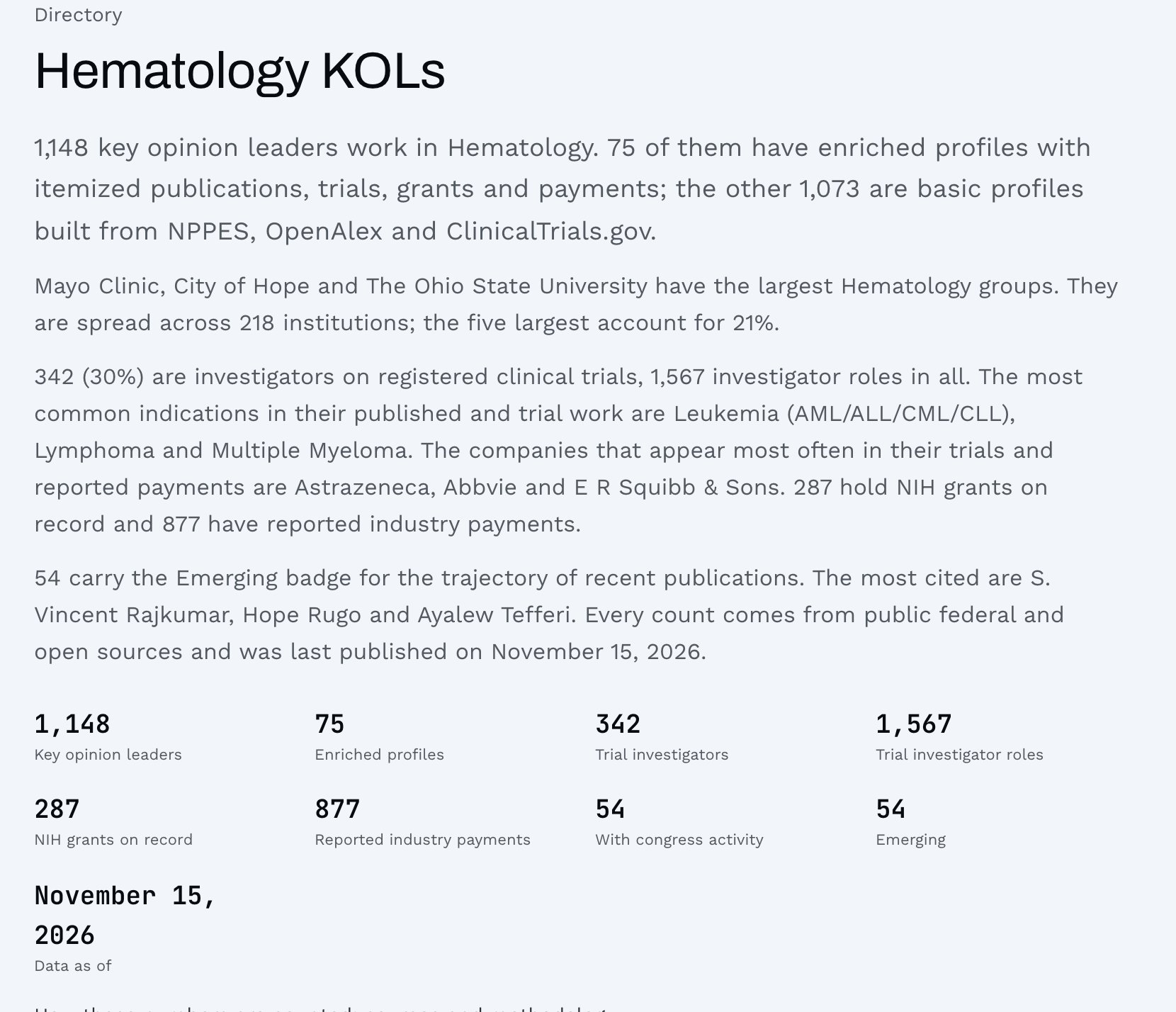
The 1,148 profiles sit across 218 institutions. 75 have enriched profiles with itemized publications, trials, grants and payments. 54 carry the Emerging badge for a rising publication trajectory.
| Figure | Value | Source |
|---|---|---|
| Registered trials with a hematology investigator | 988 (169 recruiting, 81 active not recruiting, 482 completed) | ClinicalTrials.gov |
| NIH awards, fiscal year 2025 | $90.3M across 112 projects | NIH RePORTER |
| Industry payments reported, program year 2025 | $351.8M | CMS Open Payments |
The five largest institutions hold 21% of the area:
| Institution | Hematology profiles |
|---|---|
| Mayo Clinic | 81 |
| City of Hope | 57 |
| The Ohio State University | 47 |
| The University of Texas MD Anderson Cancer Center | 32 |
| Stanford University School of Medicine | 22 |
| Memorial Sloan Kettering Cancer Center | 20 |
| University of Michigan | 20 |
Trial investigators, 30% of the area
342 hematology profiles are investigators on registered trials, with 1,567 investigator roles between them. That is 30% of the area. Across oncology as a whole the share is 9%: 14,713 of 170,154 profiles.
For a field team, that density matters. A hematology list built from trial activity reaches a third of the area directly, and the 169 recruiting studies are the most concrete topics for a first conversation. To see every trial one physician has worked on, and what the registry leaves out, read finding every trial a physician has worked on.
Grants and payments
275 hematology profiles hold NIH grants on record. In fiscal year 2025, NIH RePORTER lists $90.3M across 112 projects for the area.
877 profiles have industry payments reported under CMS Open Payments, $351.8M in program year 2025. AstraZeneca, AbbVie and E R Squibb & Sons appear most often across their trials and payments; the names are the registries' own. A payment record is a reported transfer of value. It describes a relationship, not a judgment about it.
The myeloma list, run and read
We ran the search an MSL would run for a myeloma territory: indication multiple myeloma, United States, ordered by activity in the indication. That order counts papers tagged to myeloma plus trial roles in it, each trial weighted as ten papers. It returned 3,686 profiles. The first ten:
| # | Name | Institution | Registered trials (all indications) |
|---|---|---|---|
| 1 | Kenneth Anderson | Dana-Farber Cancer Institute | 5 |
| 2 | Shaji Kumar | Mayo Clinic | 40 |
| 3 | Paul Richardson | Dana-Farber Cancer Institute | 18 |
| 4 | Angela Dispenzieri | Mayo Clinic | 13 |
| 5 | Morie Gertz | Mayo Clinic | 7 |
| 6 | Nikhil Munshi | Dana-Farber Cancer Institute | 8 |
| 7 | S. Vincent Rajkumar | Mayo Clinic | 11 |
| 8 | Sagar Lonial | Emory University | 9 |
| 9 | Martha Lacy | Mayo Clinic | 7 |
| 10 | Bart Barlogie | Icahn School of Medicine at Mount Sinai | 13 |
Three things stand out. The list leans on two centers: five Mayo Clinic names and three from Dana-Farber. The trial counts cover every indication, so open each profile's trials section to see which studies are in myeloma. And Bart Barlogie's latest recorded activity is 2020, a reminder to read the last active year before you plan outreach.
A national top ten is not a territory list. Add your region or states and sort the same way, as building a starter KOL list does for myeloma in the Midwest, then track the names you keep on your Personal board.
Before ASH 2026, and the meetings after it
The 68th ASH Annual Meeting runs December 12 to 15, 2026, in New Orleans. FindMyCongress lists it with its source and links to its Who is presenting page on FindMyKOL, which names the KOLs on the meeting's published program with their roles.
- Open Who is presenting and mark the names from your list who are on the program.
- Note the session where each one presents, so a pre-meeting contact has a reason.
- For program names not on your list, open the profile and decide whether they belong on it.
- After the meeting, check the abstracts as they post and update each profile's notes in your CRM.
The page shows the program FindMyKOL holds. Until the new program is published, that can be the previous edition, so check the year on the page.
ASH is one meeting of several. For a 2027 plan, search the same calendar for the hematology meetings that follow it, such as EBMT, HTRS, BSH and iwCLL, and run the same four steps for each.
What to take into ASH season
- Search by indication, not by area. The hematology hub counts people tagged to the area; the blood-cancer leaders you need may be tagged to oncology. The indication search finds them either way.
- Read the last active year. A highly cited name can be winding down. Check the latest year on the card before you plan outreach.
- Date the plan. Match your list to the ASH program and to the next two quarters of meetings, then assign each name to the MSL who holds it, as the territory map walkthrough shows.
Sources and date
Every hub figure above was read from the hematology hub and the oncology hub on November 20, 2026, where each figure names the registry it came from. The myeloma ranking was run in the directory the same day. The counts change with each data publish.
Questions
- How many hematology KOLs are there?
1,148 profiles work in hematology in the FindMyKOL directory as of November 20, 2026, across 218 institutions. That count follows the area tag from published and trial work. Many blood-cancer specialists are tagged under oncology instead, so for leukemia, lymphoma or myeloma search by indication: multiple myeloma alone returns 3,686 US profiles.
- Who are the top multiple myeloma KOLs in the US?
Ranked by activity in the indication (papers tagged to myeloma plus trial roles in it) on November 20, 2026, the first five were Kenneth Anderson, Shaji Kumar, Paul Richardson, Angela Dispenzieri and Morie Gertz. Five of the top ten are at Mayo Clinic and three at Dana-Farber Cancer Institute.
- Who are the most cited hematology KOLs?
S. Vincent Rajkumar, Hope Rugo and Ayalew Tefferi lead the hematology hub by citations on OpenAlex.
- How many hematology KOLs run clinical trials?
342 are investigators on trials registered on ClinicalTrials.gov, with 1,567 investigator roles in all. They appear on 988 distinct registered trials: 169 recruiting, 81 active and not recruiting, and 482 completed.
- How do I find out who is presenting at ASH?
FindMyCongress lists the ASH Annual Meeting with its dates and source, and links to its Who is presenting page on FindMyKOL. That page names the KOLs on the meeting's published program with their roles, such as invited speaker or session chair. When the new program is not out yet, it shows the previous edition's.
- Does the directory rank hematology KOLs by influence?
Not on public pages. Public pages show the records and their sources. The FindMyKOL type (Elite, National, Regional) is a judgment shown only on unlocked profiles.